Archive — first competition season. This article preserves the dates, conditions and plans reported at the time.
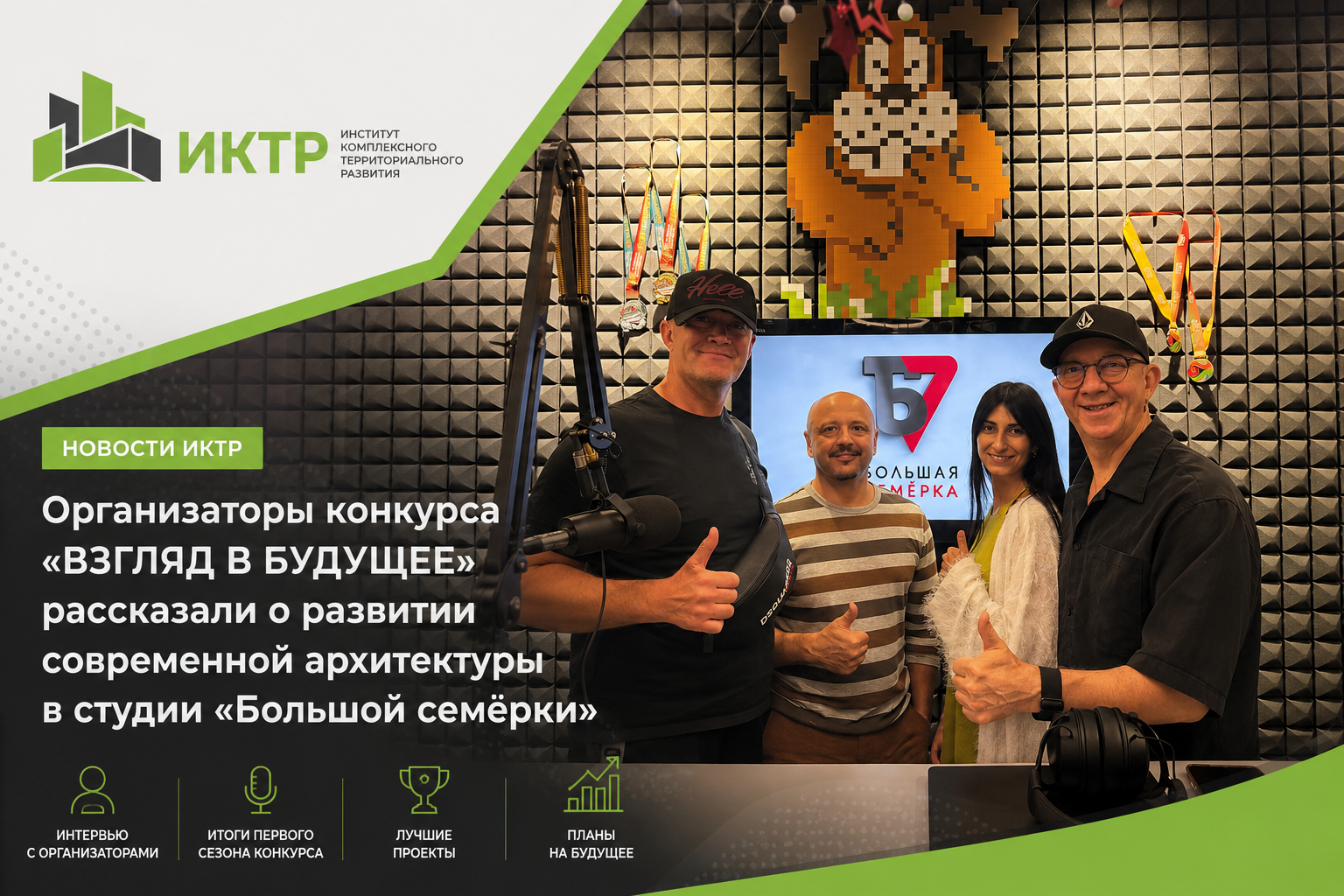
At the Bolshaya Semyorka studio, Karina Astaplyuk, General Director of the Institute for Integrated Territorial Development, and Vasily Greben, Director of TransCity LLC, historian and urbanist, discussed the origins of the national architectural competition A Glimpse into the Future, its standout entries and its growing role as a professional platform for young Russian architects.
Architecture should improve lives
The organisers explained that the competition began with a desire to give talented architects an opportunity to be heard.
Russia has many students, young architects and designers whose ideas do not always receive professional assessment or reach a wider audience.
The competition was created to prioritise the quality of an architectural idea, bold thinking and a project's potential, rather than the author's status or experience.
“Architecture that deserves to be built should not remain just an attractive drawing. It should improve life and create comfort for us and future generations. Share your vision of the architecture of the future, and together we will bring it to life.”
According to the organisers, the competition brought students, young professionals and established architects together. It also offered an insight into how designers themselves imagine the future of Russian cities, public spaces and housing.
Why A Glimpse into the Future?
The name reflects the philosophy of the architectural profession. Whether a home, public space or park, a project is designed for more than a single year. Architects shape environments in which people will live decades from now.
The competition's main purpose is to show how emerging and practising architects imagine future cities and the ways people might live in new urban environments.
How were the winners selected?
The organisers stressed that the expert jury assessed much more than visual appeal. The main criteria were:
• originality of the architectural idea;
• strength of architectural expression;
• quality of the design solution;
• feasibility in Russian conditions;
• social value;
• environmental performance and sustainability.
• originality of the architectural idea;
• strength of architectural expression;
• quality of the design solution;
• feasibility in Russian conditions;
• social value;
• environmental performance and sustainability.
Projects proposing new ways of living and unconventional approaches to territorial development received particularly high scores.
From the city to the home
The first season featured three categories at different scales of architectural design. Urban Planning focused on cities and territories. Concept Design for a Building of Any Function addressed public buildings that shape the city. Design for an Individual Residential Building explored the space closest to everyday life: the home.
Entries therefore covered the principal scales of contemporary architecture, from masterplans to individual housing.
Projects that stood out
During the broadcast, the organisers discussed several projects that made a particular impression on the jury.
METApark in Yuntolovo, St Petersburg, proposes a new relationship between people and nature. Its site is divided into nine distinct park zones, from open marshland and floodplain forest to an embankment and conservation area, each with its own ecological character and uses.
Among the Panel Blocks, Moscow, demonstrates how standardised housing areas can be transformed without large-scale demolition. Its concept uses a 3 × 3 metre modular grid reflecting the dimensions of existing panels, turning a familiar urban environment into the foundation for new public space.
Among the public-building entries, the organisers highlighted Lomonosov 2, a contemporary research and education centre where architecture, public realm and natural landscape form one continuous system.
In individual housing, Smile attracted attention with an unusual home that combines family comfort with opportunities for additional income without compromising the quality of the living environment.
Exceeding expectations
The organisers said the first season met their expectations and exceeded them in many respects.
They particularly welcomed the broad understanding of architecture shown by entrants. Many projects looked beyond striking buildings to address ecology, the social environment, cultural heritage and quality of urban life.
The wide geographical reach was another important result. Entries came from almost every part of Russia, demonstrating the professional community's strong interest in such initiatives.
International ambitions and new categories
The competition's development continues. The organisers are already working on the next season and plan to take it to an international level.
New categories are also being considered, including Apartment Buildings, focused on contemporary residential architecture, and A Glimpse into the Future Through the Past, bringing together heritage conservation, revitalisation and contemporary reinterpretations of historic sites.
The first season showed that the Russian architectural community is ready for open professional discussion and new solutions. A Glimpse into the Future will continue to develop as a platform for ideas that could become part of real cities.